
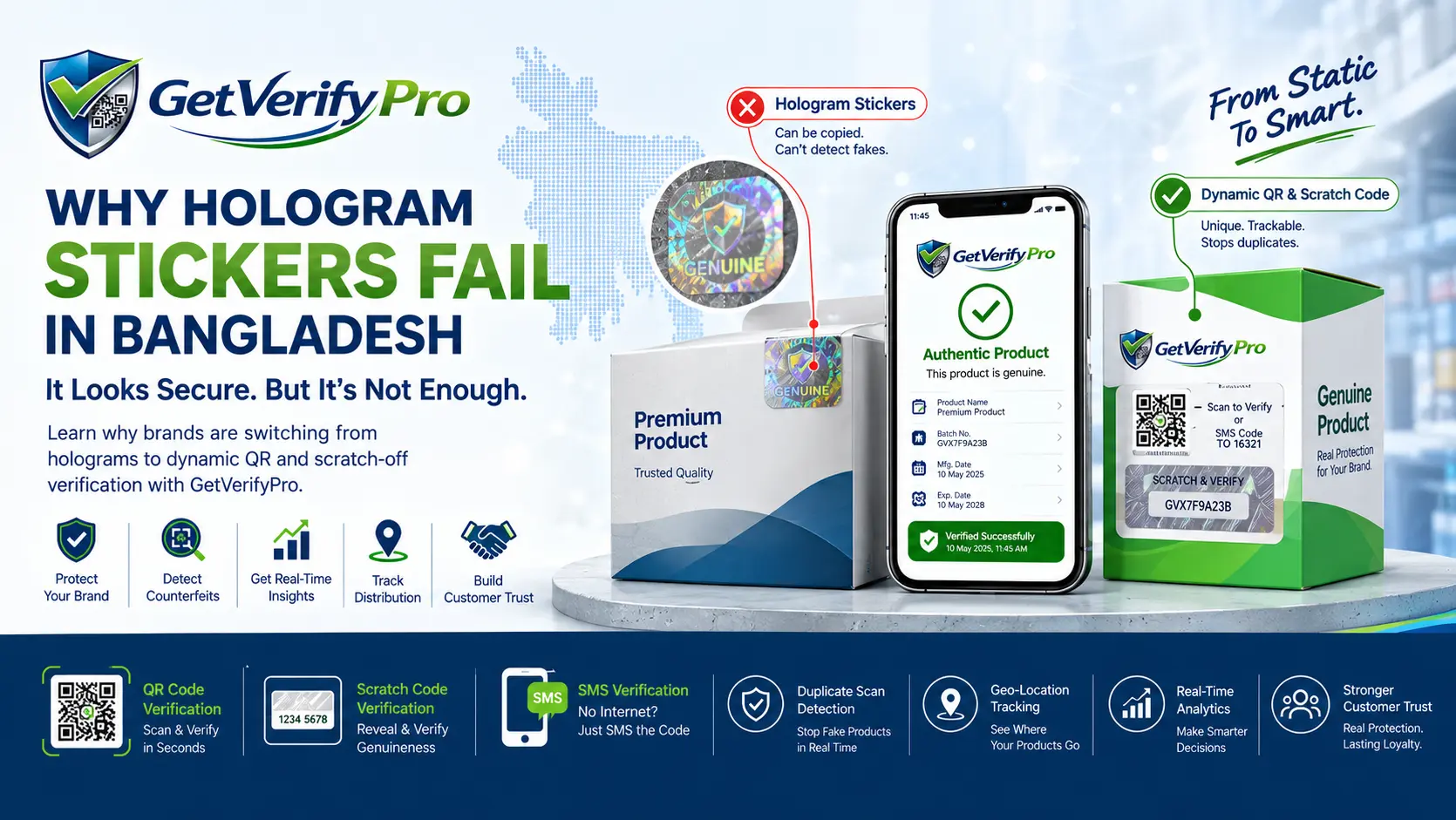
When a Bangladeshi brand first discovers its products are being counterfeited, the instinctive first move is almost always the same: go to a local press and order a hologram sticker. It's the oldest, most familiar anti-counterfeit tool on the market. It's also, on its own, no longer enough — and understanding exactly why is the difference between spending money on a label that looks secure and investing in a system that actually is.
Hologram stickers work as a deterrent, not a lock. Their core security feature is that they're difficult, not impossible, to reproduce — a distinction that matters far more than it sounds. Industry analysis of brand protection technology has been direct about this limitation for years: a determined counterfeiter with the right equipment, patience, and access to stolen design files can replicate even sophisticated holographic images. What looks like a secure, tamper-evident feature to a customer in a shop is, to a well-resourced counterfeiting operation, simply another manufacturing problem to solve.
The scale of what's at stake makes this more than a theoretical concern. The World Health Organization has estimated that counterfeit and substandard medicines generate more than $32 billion in illicit annual sales globally — much of it in exactly the kind of packaged, hologram-labeled products this guide is about. A widely cited case study on counterfeit antimalarial medication found that fake holograms were technically identifiable on close inspection, but in markets with lower literacy and informal retail channels, most buyers simply saw a shiny sticker and assumed it meant "genuine" — without any way to actually confirm it.
Visit GetVerifyPro Website: www.getverifypro.com
Visit Appnexaa Website For Product Details: www.appnexaa.com
Bangladesh's retail landscape makes this weakness particularly costly. Products move through multi-tier distribution — brand to distributor to dealer to retailer to consumer — and by the time a product reaches a shop in a secondary market, there's no realistic way for a brand to confirm every hologram sticker in circulation is one it actually issued. Counterfeiters don't need to defeat the brand's official label at the point of manufacture; they only need a convincing copy that survives a quick glance at the point of sale.
This creates a specific and expensive failure mode: a brand pays for a hologram sticker specifically to prevent counterfeiting, and the counterfeiters simply add a copied version of that same sticker to their fake product — meaning the security feature the brand paid for ends up lending false credibility to the very fakes it was meant to expose. Static security features fundamentally cannot verify themselves; they rely entirely on a human, in the moment, correctly judging authenticity by eye. In a crowded pharmacy, hardware shop, or electronics counter, that judgment call is unreliable at best.
The core structural gap is this: a hologram is a static, one-way signal. It's printed once and never changes, which means it can never tell a brand anything after the fact — not where it was scanned, not how many times, not whether the same design has already turned up on a suspicious cluster of products in one district. A dynamic QR code or scratch-off verification code, by contrast, is a two-way system. Every time it's checked, it reports back — creating a live, growing record of exactly how and where the product is actually being used and verified.
This is the single biggest reason Bangladeshi brands are shifting from static holograms to digital verification: not because QR codes are impossible to copy in theory, but because a properly built digital system can catch a copy attempt in the act, through duplicate scan detection, while a hologram sticker has no equivalent defense at all.
Visit GetVerifyPro Website: www.getverifypro.com
Visit Appnexaa Website For Product Details: www.appnexaa.com
Hologram and static security labels remain widely used across several major sectors in Bangladesh:
Every one of these industries adopted holograms for the same reason: it was, for a long time, the most accessible security technology available. The problem isn't that these brands made a poor decision — it's that the technology itself has a structural ceiling that digital verification doesn't share.
The limitations of a hologram-only strategy don't show up as a single dramatic loss — they show up as a slow, hard-to-trace erosion that compounds over time:
Visit GetVerifyPro Website: www.getverifypro.com
Visit Appnexaa Website For Product Details: www.appnexaa.com
| Factor | Traditional Hologram Sticker | Dynamic QR / Scratch-Off Verification |
|---|---|---|
| Can be copied | Yes, with sufficient equipment and access | Each code is unique and tied to a real-time system |
| Detects duplication | No — a copied hologram looks identical to the original | Yes — duplicate scan detection flags abnormal reuse |
| Provides usage data | No — a printed sticker reports nothing | Yes — every scan is logged with time and location |
| Verifiable by the customer | Only by visual judgment | Instantly, via scan or SMS, with a clear result |
| Works without internet | Yes, but with no verification capability | Yes, through SMS-based verification |
| Cost model | Per-sticker printing cost, no ongoing intelligence | Usage-based, with real-time fraud data included |
GetVerifyPro, developed by AppNexaa, is built around exactly the gap holograms leave open. Instead of a one-way printed image, every product gets a unique, verifiable digital identity — combining several methods so brands aren't limited to a single point of failure.
Core features:
Visit GetVerifyPro Website: www.getverifypro.com
Visit Appnexaa Website For Product Details: www.appnexaa.com
It's worth being specific about the mechanism, since this is the single capability that makes the biggest practical difference. When a hologram is copied, there's no way to distinguish the fake from the original — both look identical, and neither reports back anything to anyone. A dynamic verification code works differently, because every scan creates a data point.
If a single code is verified once, in one location, by one customer, that's a normal pattern. If the same code is suddenly scanned multiple times from different areas of the country within a short window, that's a strong signal the code has been photographed, copied, and printed onto counterfeit units being sold in parallel. The system flags this automatically — not after a customer complains weeks later, but at the moment the abnormal pattern occurs. This is the exact capability a static hologram, however well-designed, structurally cannot provide, because it has no mechanism to report usage at all.
The practical shift is from a one-time, static defense to a continuously improving one. A hologram sticker offers exactly the same level of protection on day one as it does two years later — it cannot learn, adapt, or report anything back. A digital verification system gets more useful the longer it runs, because every scan — genuine or fraudulent — adds to the pattern data a brand can act on. That's the difference between buying a security feature and running an active brand protection system.
One reason brands hesitate to move away from hologram stickers is the assumption that switching security technology means overhauling production. In practice, the transition is closer to a like-for-like sticker swap than a manufacturing change. GetVerifyPro generates unique QR and scratch-off codes as print-ready sticker sheets that apply during the exact same packaging step a hologram sticker currently occupies — no new machinery, no production-line redesign, and no retraining of packaging staff beyond where the new sticker goes.
For brands that aren't ready to remove hologram stickers entirely — often for regulatory, retailer-familiarity, or transitional reasons — the two can run side by side, with the QR or scratch-off code providing the real-time verification and fraud detection the hologram never could, while the visual hologram remains as a familiar first-glance cue for customers and retailers.
Visit GetVerifyPro Website: www.getverifypro.com
Visit Appnexaa Website For Product Details: www.appnexaa.com
On a pure per-unit basis, a hologram sticker can look cheaper than a digital verification code, especially at high print volumes. But comparing sticker prices alone misses what each option actually delivers. A hologram's cost is fixed and one-time — printing, and nothing else, regardless of whether it succeeds or fails at stopping a counterfeiter. A digital verification system's cost includes the code itself plus an ongoing service: real-time fraud detection, location data, and a growing record of exactly how the product moves through the market.
Platforms like GetVerifyPro price this on a usage basis — brands pay per verification code rather than a large upfront licensing fee, with a free tier available for smaller-scale testing before committing to a full rollout. Framed this way, the comparison isn't "cheap sticker versus expensive software" — it's "a label that does one thing once, versus a system that keeps working every time a customer checks."
Why do hologram stickers fail to stop counterfeiting? Hologram stickers are a static, one-way security feature — they can be visually convincing but, with the right equipment and access to design files, can be reproduced by determined counterfeiters. Once copied, a fake hologram looks identical to a genuine one and offers no way to detect the duplication.
Are hologram stickers completely useless? Not entirely — they still act as a basic deterrent and can be a useful first-line visual cue. The issue is relying on them as a brand's only anti-counterfeit measure, since they provide no real-time verification, no usage data, and no way to detect a successful copy.
What's the difference between a static hologram and a dynamic QR code? A hologram is printed once and never changes or reports anything back. A dynamic QR or scratch-off code is checked against a live system every time it's scanned, allowing duplicate scan detection, location tracking, and instant authenticity confirmation — none of which a hologram can provide.
Can a digital verification system work in areas where hologram stickers are currently used because of low internet access? Yes. Systems like GetVerifyPro include SMS-based verification specifically for this reason, so customers without internet access can verify a product by texting its code to a short number, with no smartphone or data connection required.
Should a brand replace hologram stickers immediately, or can both be used together? Many brands transition gradually, using a QR or scratch-off code alongside existing packaging elements before fully phasing out hologram-only security, since the switch mainly involves updating the packaging sticker itself rather than the production line.
Is a dynamic QR code more expensive than a hologram sticker? The per-unit cost is comparable, and often lower at scale since it doesn't require specialized holographic printing equipment. The more important difference is what the cost buys: a hologram provides a one-time, unchanging visual feature, while a digital code provides ongoing verification, duplicate detection, and usage data for the same or lower unit cost.
Visit GetVerifyPro Website: www.getverifypro.com
Visit Appnexaa Website For Product Details: www.appnexaa.com
A hologram sticker can look secure without actually being secure — and a copied one gives counterfeiters exactly the credibility they need. Book a 1-on-1 demo with GetVerifyPro to see how dynamic QR, scratch-off codes, and real-time duplicate detection give your brand protection a hologram simply can't.