
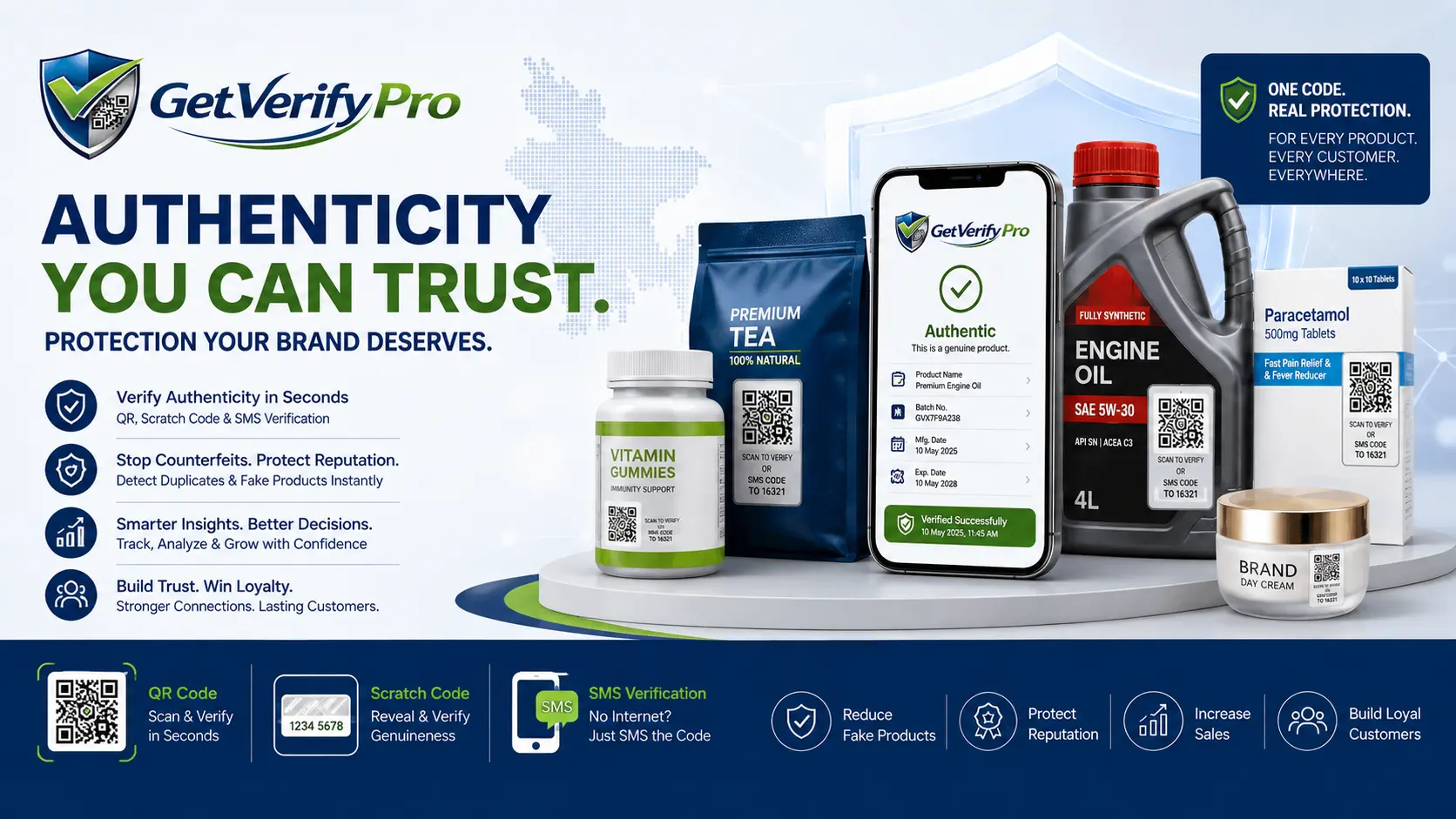
If you've searched for a product authentication solution in Bangladesh, you already know the problem you're trying to solve: your product — or a product that looks exactly like it — is being sold as something it isn't. What you may not know yet is what actually separates a real solution from a sticker that only looks secure. This guide breaks down what product authentication means in practice, what's actually happening in the Bangladeshi market right now, how the technology works, and — because this is the platform we build — exactly how GetVerifyPro solves it end to end.
Visit GetVerifyPro Website: www.getverifypro.com
Visit Appnexaa Website For Product Details: www.appnexaa.com
Counterfeiting in Bangladesh isn't a fringe problem — it's a mainstream one. Industry estimates place counterfeit and substandard goods at roughly 35–40% of the domestic market across categories, spanning everything from cosmetics and food products to automotive lubricants and electronics. Government sources have separately estimated that counterfeiting costs the country billions of taka annually in lost tax revenue and legitimate business sales.
The consequences go beyond lost sales. A 2023 study published in a leading science journal found that close to 10% of antibiotics sold in Dhaka were substandard or falsified — a stark reminder that this isn't only a brand-reputation issue, it's a public safety one in categories like pharmaceuticals and healthcare products.
For a brand owner, this creates a specific, urgent search: not "how do I stop counterfeiting in general" but "what actual system can I put in place, starting with my next production batch."
A product authentication solution is a system that gives a physical product a verifiable digital identity, so that anyone — a customer, a retailer, or a service center — can confirm whether it's genuine, usually in seconds. This is different from older anti-counterfeit measures like holograms or embossed logos, which can eventually be replicated by determined counterfeiters. A proper digital authentication solution ties each unit to a unique, verifiable code that's checked against a central system in real time, rather than relying on a static visual feature that can be copied.
In the Bangladeshi context specifically, a genuinely useful solution needs to account for one more factor most global platforms overlook: not every customer has reliable internet access. A verification method that only works through a smartphone app or website leaves out a large share of the country's rural and lower-connectivity consumer base.
Visit GetVerifyPro Website: www.getverifypro.com
Visit Appnexaa Website For Product Details: www.appnexaa.com
GetVerifyPro, developed by AppNexaa, is a smart product authentication and brand protection platform built to answer exactly the question this guide is about. Rather than being a global platform adapted for Bangladesh as an afterthought, it was designed around the specific realities of the Bangladeshi retail and distribution landscape from day one: multi-tier distribution chains where brands lose contact with the end buyer, a large rural population without reliable data access, and a counterfeit problem that spans nearly every product category rather than being confined to one industry.
At its core, GetVerifyPro gives every unit a brand sells — a bottle, a box, a battery, a bag of medicine — a unique, verifiable digital identity. A customer, a retailer, or a service center can confirm authenticity in seconds, using whichever verification method fits the situation: a smartphone scan in Dhaka, or a simple SMS from a village with no data connection at all.
Visit GetVerifyPro Website: www.getverifypro.com
Visit Appnexaa Website For Product Details: www.appnexaa.com
Features on a list are one thing; understanding how they change day-to-day operations is another. Here's what each capability looks like in practice for a Bangladeshi brand.
Product registration becomes a one-time setup, not an ongoing burden. A brand uploads its product and batch details once — name, SKU, manufacturing date, expiry date — and GetVerifyPro generates the unique codes and print-ready stickers automatically. These are applied during standard packaging, with no changes needed to an existing production line.
Verification becomes something the customer does themselves, at no cost to the brand's staff. Instead of a customer calling a hotline or visiting a shop to ask "is this real," they scan or text a code and get an answer immediately. This removes friction from the point that matters most — the moment of purchase, when trust is either confirmed or lost.
Fraud detection becomes automatic instead of reactive. Traditionally, a brand only discovers counterfeiting after a customer complains, or after sales in a region mysteriously drop. With duplicate-scan detection running continuously in the background, unusual scan patterns are flagged the moment they happen — often before the brand's own sales team would have noticed anything was wrong.
Distribution visibility replaces distribution guesswork. Geo-tracking data shows a brand exactly where its products are being verified, which — cross-referenced against where they were actually distributed — can reveal grey-market leakage, unauthorized regional resellers, or counterfeit hotspots long before any formal investigation would catch it.
Warranty service stops being a dispute and becomes a lookup. A service center technician scans the code instead of inspecting a paper slip for signs of tampering, and gets a definitive answer on coverage status in seconds — reducing both fraudulent claims and, just as importantly, wrongful denials of legitimate ones.
The brand finally sees its own end customers. For a business selling through distributors and dealers, GetVerifyPro's consent-based data collection is often the first time the brand has ever had direct, permission-based contact information for the people actually using its products — turning a one-time sale into the possibility of a repeat relationship.
Visit GetVerifyPro Website: www.getverifypro.com
Visit Appnexaa Website For Product Details: www.appnexaa.com
Brand value isn't an abstract idea — it's the accumulated result of every time a customer trusted a product and it delivered. Counterfeiting attacks that trust directly, and once it's damaged, it's disproportionately expensive to rebuild compared to what it cost to protect in the first place.
GetVerifyPro is built to defend brand value on three layers simultaneously, which is what makes it a meaningfully strong solution rather than a single-purpose tool:
Layer 1 — Prevention at the point of sale. Because every genuine unit carries a unique, verifiable code, a counterfeit product simply cannot pass verification. This shifts the burden of proof from "trust the label" to "prove it in three seconds," which is a fundamentally stronger position for a brand to defend from.
Layer 2 — Detection across the supply chain. Duplicate-scan alerts and geo-tracking mean counterfeiting doesn't have to be discovered by accident. A brand can see, in near real time, where verification patterns look abnormal — turning brand protection from a reactive, after-the-fact investigation into an ongoing monitoring function.
Layer 3 — Trust reinforcement with the end customer. Every successful, positive verification is itself a small brand-trust moment — a customer who scans and sees "Authentic Product ✅" walks away more confident in the brand than one who simply assumed the product was genuine. Over thousands of scans, this compounds into a measurable trust advantage that competitors relying on old-style holograms or printed seals cannot match.
Combined with warranty management and campaign tools running on the same verified-purchase data, GetVerifyPro isn't just stopping a specific bad outcome — it's actively building the kind of verifiable, provable trust that becomes a competitive advantage in a market where 35–40% of goods are counterfeit or substandard.
It's worth being direct about the two sides of this decision, because the cost of inaction is often invisible until it's already large.
The pattern across nearly every business that delays this decision is the same: the cost of counterfeiting doesn't announce itself as one large event. It shows up as a slow, steady erosion of sales and trust that's difficult to attribute to any single cause — which is exactly why it tends to be underestimated until a system like GetVerifyPro makes it visible for the first time.
Visit GetVerifyPro Website: www.getverifypro.com
Visit Appnexaa Website For Product Details: www.appnexaa.com
Duplicate and counterfeit products don't just steal a single sale — they steal the ability of a genuine product to prove itself. Once a convincing fake is in the market, every genuine unit has to work harder to earn trust, because the customer's default assumption shifts from "this is probably real" to "how do I know this isn't fake."
This is precisely why duplicate-detection technology matters as much as authenticity verification itself. A system that only confirms "this code exists in our database" isn't enough — a cloned or photographed code can pass that check. What actually stops counterfeiting is a system that tracks how many times and where each code has been used, and flags the moment a pattern looks wrong. This is the difference between a static security label and an active, ongoing fraud-prevention system — and it's why GetVerifyPro treats duplicate detection as a core feature rather than an add-on.
For Bangladeshi brands specifically, this fight matters on three fronts at once: protecting immediate revenue, protecting long-term brand equity that took years to build, and — in categories like pharmaceuticals, batteries, and automotive parts — protecting customer safety, where a counterfeit product isn't just a financial loss but a genuine risk.
Not every product category needs the same verification method, and the strongest solutions offer more than one:
GetVerifyPro supports all three methods in one platform, because the right method often depends on where — not just what — you're selling.
If you're evaluating providers, a few criteria separate a serious platform from a superficial one — and this is the exact checklist GetVerifyPro was built against:
Visit GetVerifyPro Website: www.getverifypro.com
Visit Appnexaa Website For Product Details: www.appnexaa.com
Because pricing scales with actual usage — starting with a free tier for testing up to 500 verification tokens — brands of any size can evaluate the system on their own product line before committing to a larger rollout. There's no large upfront software purchase or annual license fee; you pay only for the QR tokens you actually use. Deployment, from product registration to full go-live, typically takes around six weeks.
What is the best product authentication solution in Bangladesh? The right solution depends on your product and distribution reach, but the strongest options combine multiple verification methods — QR code, scratch-off code, and SMS — so both urban, smartphone-equipped customers and rural, low-connectivity customers can verify authenticity. GetVerifyPro is built to support all three from a single platform.
How much does a product authentication system cost in Bangladesh? Most platforms price based on usage — typically per verification code or QR token — rather than a large upfront license fee, so cost scales directly with how many units you're protecting rather than a fixed annual cost.
Can a product authentication solution work without internet? Yes, if it includes SMS-based verification. This allows a customer to text a unique code printed on the product to a dedicated number and receive an instant authenticity confirmation, with no app or data connection required.
How does duplicate detection actually stop counterfeiting? By tracking how many times and from where each unique code is verified, the system can flag abnormal patterns — such as the same code being scanned repeatedly across different locations — which is a strong signal that a code has been cloned or reused on counterfeit units.
How long does it take to implement a product authentication system? For a system like GetVerifyPro, implementation — covering product registration, code generation, sticker printing, and staff/dealer training — typically takes about six weeks before a brand is fully live.
What happens to a business that doesn't adopt any authentication system? It continues absorbing counterfeit-driven revenue loss and reputational damage without any way to measure or address it — since without a verification system, there's usually no reliable way to even know how much counterfeiting is actually happening.
Visit GetVerifyPro Website: www.getverifypro.com
Visit Appnexaa Website For Product Details: www.appnexaa.com
Choosing a product authentication solution isn't just about stopping counterfeits after the fact — it's about giving your customers a way to trust your brand before they even open the box, and giving your business the data and control it never had under a paper-based system. Book a 1-on-1 demo with GetVerifyPro to see exactly how QR, scratch-code, and SMS verification can be deployed across your product line in as little as six weeks.
Visit GetVerifyPro Website: www.getverifypro.com
Visit Appnexaa Website For Product Details: www.appnexaa.com