
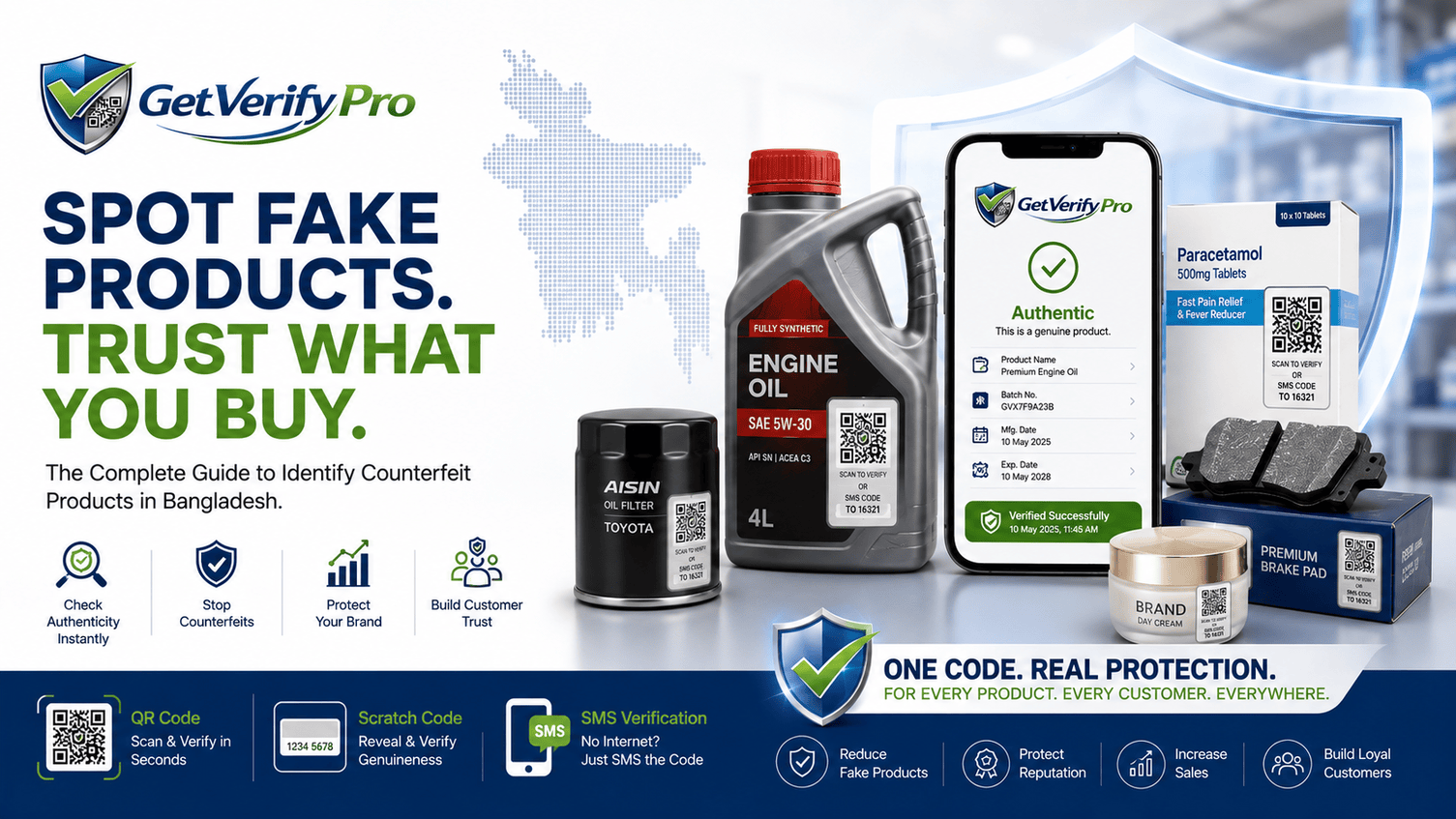
Fake products in Bangladesh are no longer a small, occasional problem confined to street markets. They've become a nationwide issue touching almost every category of consumer goods — from the engine oil in your bike to the medicine in your cabinet, the cosmetics on your shelf, and the spare parts under your car's hood.
Recent reporting from Dhaka Tribune paints a clear picture of just how large this problem has become. Industry investigations point to counterfeit goods costing the government several thousand crore taka in lost tax revenue every year, while legitimate businesses lose an even larger amount in sales they never actually made — because a counterfeit version was sold instead. The same reporting found counterfeit versions of edible oil, powdered milk, bottled water, soft drinks, cosmetics, and electrical goods circulating with fake regulatory certification marks, often manufactured in unauthorized factories and sold through ordinary retail channels, not just hidden black markets.
This guide brings together how to identify fake products in Bangladesh, category by category, and — just as importantly — explains why the old advice of "check the packaging carefully" is no longer enough on its own, and what's actually replacing it.
Visit GetVerifyPro Website: www.getverifypro.com
Visit Appnexaa Website For Product Details: www.appnexaa.com
A few forces are driving this problem at the same time:
The result is a market where genuine brands lose sales to their own counterfeit copies, government loses tax revenue, and consumers absorb the real cost — whether that's a damaged engine, a health risk, or simply money spent on something that doesn't work as promised.
While no single trick works across every product type, most manual checks fall into similar patterns. Here's a category-by-category breakdown of what to look for.
Check the tamper-proof seal for signs of resealing, compare label print quality against a genuine bottle, inspect the oil's color and consistency, and be suspicious of pricing well below the standard market rate. Fake engine oil is one of the most damaging categories, since it directly affects engine health over time. (For a full breakdown, see our detailed guide on checking original engine oil in Bangladesh.)
Compare the exact part number on both packaging and the part itself, check the finish and weight of the part, and look for a hologram, QR code, or scratch code where the brand is known to use one. Counterfeit spare parts often fail earlier than genuine ones, sometimes damaging connected components in the process. (See our full guide on identifying fake spare parts in Bangladesh.)
Examine packaging color, font, and printing quality closely, check the product's texture and scent against what you've used before, and be cautious of unusually low prices for well-known brands. Counterfeit cosmetics can contain harmful or untested ingredients that cause skin irritation or worse.
Check for a legible batch number and expiry date, verify the manufacturing license number where visible, and buy only from licensed pharmacies. Counterfeit or substandard medicine is uniquely dangerous, since it can directly affect a patient's health and delay proper treatment. If you have any doubt, consult a pharmacist or doctor rather than relying on visual inspection alone.
Check the IMEI number through the official BTRC verification system, inspect the box for print quality and correct branding, and verify the device's details match under the phone's "About" settings. Counterfeit chargers, cables, and accessories are also common and can pose safety risks beyond just poor performance.
Check for a genuine BSTI certification mark, inspect seals and expiry dates carefully, and be wary of unusually cheap pricing on well-known brands. Counterfeit food and beverage products have been found to contain harmful additives or poor-quality ingredients that pose real health risks.
Visit GetVerifyPro Website: www.getverifypro.com
Visit Appnexaa Website For Product Details: www.appnexaa.com
Every list like the one above shares the same weakness: it depends entirely on the buyer's ability to notice small details, under time pressure, often without a genuine product on hand to compare against. As counterfeiters get better at replicating packaging, holograms, and even official certification marks, the gap between "looks genuine" and "is genuine" keeps narrowing.
This is the uncomfortable truth most guides don't say directly: visual inspection is a first line of defense, not a reliable final answer. A buyer can follow every tip on this page carefully and still walk away with a convincing counterfeit, because packaging and appearance are exactly what counterfeiters focus on copying first.
What's actually needed — for consumers and brands alike — is a way to get a definite, verifiable answer, not an educated guess based on how a label looks or feels.
This is where product authentication technology changes the equation entirely. Instead of asking a buyer to spot subtle differences in print quality, modern verification systems give every genuine unit — a bottle, a part, a package — a unique, one-time code tied specifically to that item. Here's how it works:
This approach removes the guesswork entirely. Instead of relying on a buyer's judgment, the product itself carries a verifiable answer.
This is exactly the system GetVerifyPro provides to brands across Bangladesh — a complete authentication platform combining QR code, scratch code, and SMS verification, so that no customer, in any part of the country, is left checking a product by guesswork alone.
Visit GetVerifyPro Website: www.getverifypro.com
Visit Appnexaa Website For Product Details: www.appnexaa.com
For brands still relying on packaging alone, the risks tend to build quietly until they become impossible to ignore:
Two brands already facing these exact pressures in Bangladesh — AISIN Bangladesh in the engine oil category, and FaitoBD in automotive spare parts — chose to address this directly with verification technology rather than relying on packaging alone. As AISIN Bangladesh put it, the QR verification system safeguarded their brand while directly improving customer confidence and sales. FaitoBD described the same system as having strengthened their brand's credibility and helped build long-term trust with their customers in an industry where counterfeit parts were actively undermining that trust.
Brands that treat product verification as core infrastructure — rather than an optional add-on — tend to see it pay off in ways that go beyond simply blocking fakes:
In a market where an estimated tens of billions of taka are lost to counterfeit goods every year, the cost of not adopting a verification system is rarely smaller than the cost of implementing one — it's simply harder to see, because it shows up as lost sales and quiet reputational damage rather than a single line item.
GetVerifyPro provides a complete product authentication platform built for exactly the kind of counterfeiting risk described throughout this guide, regardless of your product category:
If your brand is losing sales, trust, or peace of mind to counterfeit versions of your own product, a verification system is one of the most direct ways to take back control — for your customers' safety, and for your bottom line.
How can I tell if a product is fake in Bangladesh? Check packaging print quality, seals, batch numbers, and pricing against the standard market rate. For a definite answer rather than a guess, look for a QR code, scratch code, or SMS verification option, which confirms authenticity instantly.
Which product categories are most affected by counterfeiting in Bangladesh? Reporting has identified engine oil, spare parts, cosmetics, medicine, electronics, and packaged food and beverages as categories with significant counterfeit activity, though the problem extends well beyond these.
Why isn't checking packaging enough to avoid fake products? Counterfeiters specifically focus on replicating packaging, holograms, and certification marks, since that's what most buyers rely on to judge authenticity. As replication quality improves, visual checks alone become less reliable every year.
How does QR or scratch code verification actually stop counterfeiting? Each genuine unit receives a unique, one-time code. Once that code has been verified, it can't be validly reused on another unit, so a duplicated or copied product will fail verification instantly.
Can I verify a product without internet access? Yes, if the brand offers SMS verification. You can text the unique code to a designated number and receive an instant reply confirming whether the product is genuine, without needing a smartphone or data connection.
What should I do if I think I've bought a fake product? Stop using it if possible, keep the packaging and any verification codes, and contact the seller or brand directly. If the product includes a QR or scratch code, checking it will usually confirm authenticity immediately.
Want to protect your brand from counterfeiting across every stage of the supply chain? Contact GetVerifyPro to see how QR code, scratch code, and SMS verification can be set up for your product line.
Visit GetVerifyPro Website: www.getverifypro.com
Visit Appnexaa Website For Product Details: www.appnexaa.com
Automotive & Lubricants: How to Spot Fake Engine Oil in Bangladesh (2026) – Protect your vehicle engine from substandard and recycled counterfeit oils.
Auto Parts & Safety: 7 Ways to Spot Fake Auto Spare Parts in Bangladesh (2026) – Key indicators for verifying genuine vehicle spare parts and components.
Pharmaceuticals & Healthcare: How to Check Fake Medicine in BD (2026 Guide) – Critical verification methods to ensure prescription drugs and health supplements are genuine.
Cosmetics & Skincare: How to Stop Fake Cosmetics Duplicate in Bangladesh (2026 Guide) – How beauty importers and skincare brands eliminate replica products and toxic fakes.
Offline Security Technology: How to Verify Products Without Internet: SMS Verification Guide – Fast product authentication via scratch-off SMS codes for rural and offline users.