
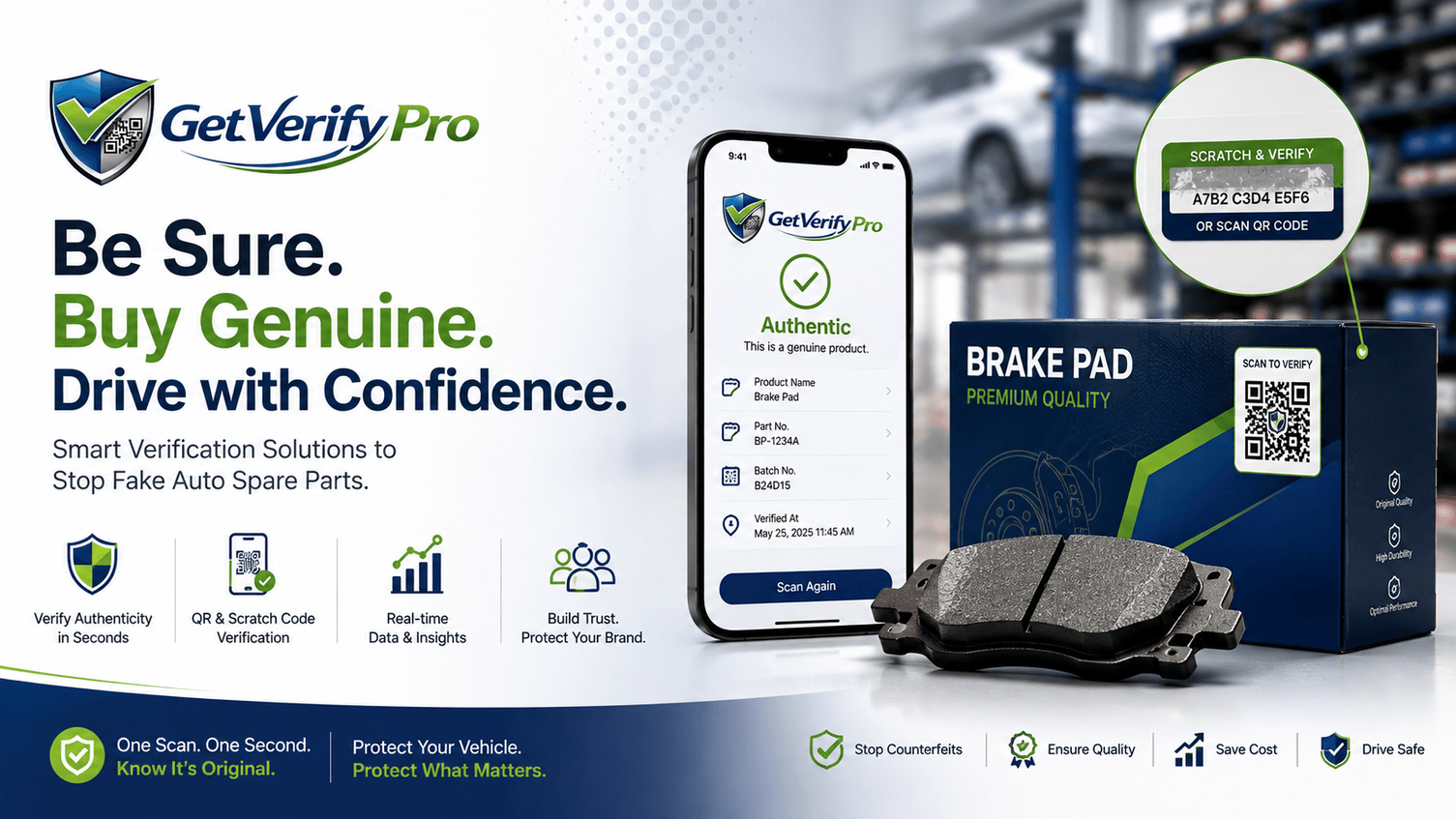
Walk into any spare parts market in Dhaka's Tejgaon, Bongshal, or Fulbaria area, and you'll find genuine parts sitting on shelves right next to counterfeit copies that look nearly identical. For a mechanic under time pressure or a vehicle owner who just needs a part replaced today, telling the two apart isn't always easy — and getting it wrong can mean a part that fails within weeks instead of years.
Counterfeit auto spare parts are one of the most common and most costly forms of product fraud in Bangladesh's automotive market. This guide covers how to identify fake spare parts in Bangladesh, the practical checks every buyer and mechanic should know, and how brands are using verification technology to finally give a definite answer instead of a guess.
Visit GetVerifyPro Website: www.getverifypro.com
Visit Appnexaa Wbsite For Product Details: www.appnexaa.com
The auto parts market has a few structural reasons why counterfeiting thrives here:
The result is a market where genuine parts manufacturers lose sales to their own counterfeit copies, and vehicle owners pay for a "genuine" part that quietly underperforms or fails early.
Visit GetVerifyPro Website: www.getverifypro.com
Visit Appnexaa Wbsite For Product Details: www.appnexaa.com
Genuine parts brands invest in consistent, high-quality packaging. Look closely for:
Counterfeit parts are often made with cheaper materials to cut costs. A part that feels noticeably lighter, has rough edges, uneven paint, or visible mold lines is a common sign of a low-quality copy.
Look for the exact part number stamped or printed on both the packaging and the part itself. Counterfeiters sometimes use a part number that's close but not identical to the genuine one, hoping buyers won't check closely.
Many established brands now include an authentication feature directly on the packaging — a hologram sticker, a QR code, or a scratch-off code. The absence of a feature the brand is known to use is itself a warning sign.
If a part is priced noticeably below what you'd expect for that brand, treat it as a red flag rather than a bargain. Genuine distributors have limited room to undercut standard pricing by a wide margin.
Parts bought from an authorized dealer or a shop with an established reputation carry far less risk than parts bought from an unfamiliar seller purely because the price was lower.
If the part includes a QR code or scratch code, scan or check it before installation — not after. Once a counterfeit part is installed and something fails, the cost of the mistake is already locked in.
Here's the honest limitation: as counterfeiters get better at replicating packaging and finish, visual inspection becomes less reliable every year. A part that passes every check on this list by eye can still be a well-made counterfeit — because packaging and appearance are exactly what counterfeiters focus on copying first.
What buyers and mechanics actually need is a way to get a definite, verifiable answer — not an educated guess based on how the box looks or feels. This is exactly the gap that product authentication technology is designed to close.
Modern authentication systems give every part a unique, one-time verification code tied to that specific unit. Here's how it works in practice:
For markets and workshops with limited internet access, SMS-based verification lets a mechanic or buyer text the code and get an instant authenticity confirmation, no app or data connection required.
This is exactly the kind of system GetVerifyPro provides to spare parts brands: QR code, scratch code, and SMS verification, working together so no buyer is left checking a part by guesswork alone.
Visit GetVerifyPro Website: www.getverifypro.com
Visit Appnexaa Wbsite For Product Details: www.appnexaa.com
For spare parts manufacturers and distributors, staying with packaging alone as the only line of defense tends to create problems that compound over time:
This is precisely the problem FaitoBD, a well-known name in Bangladesh's after-market spare parts industry, faced before adopting a verification system. In their own words:
"GetVerifyPro has been a game-changer for us in the automotive parts industry. By using their QR verification system, we've been able to assure our customers of the authenticity of our spare parts, preventing the distribution of counterfeit products. This has strengthened our brand's credibility and helped us build long-term trust with our customers."
That's not a hypothetical benefit — it's a real spare parts brand in Bangladesh describing the exact problem this article covers, and what changed once they solved it.
For spare parts brands, authentication technology works less like an added expense and more like a combination of insurance and a growth tool:
Brands that treat verification as core infrastructure — not an optional add-on — are the ones building lasting credibility in a market where trust, once lost, is expensive to rebuild.
GetVerifyPro provides a complete product authentication platform built for brands facing exactly this kind of counterfeiting risk in Bangladesh's auto parts market:
If your brand manufactures or distributes spare parts in Bangladesh and counterfeiting is cutting into your sales and your customers' trust, this is exactly the kind of protection worth putting in place before the problem grows any further.
How can I tell if a spare part is genuine in Bangladesh? Check the packaging print quality, part number accuracy, finish, and weight, and buy from authorized dealers. For a definite answer, look for a QR code, scratch code, or SMS verification feature, which confirms authenticity instantly rather than relying on visual inspection alone.
What should I do if I think I bought a fake spare part? Stop using it if it hasn't been installed, keep the packaging and any verification codes, and contact the seller or brand directly. If the part has a QR or scratch code, checking it will usually confirm authenticity immediately.
Can fake spare parts damage my vehicle? Yes. Counterfeit parts are often made with lower-quality materials and looser tolerances, which can lead to premature failure, reduced performance, and in some cases damage to other components connected to that part.
How does QR code verification prevent counterfeit spare parts? Each part receives a unique, one-time code. Once that code has been verified, it cannot be validly reused on another part, so a duplicated or copied part will fail verification instantly.
Is SMS verification useful for spare parts sold in workshops without internet? Yes. SMS-based verification lets buyers and mechanics confirm authenticity by text message, which is especially useful in workshops and markets where reliable internet access isn't guaranteed.
Want to protect your spare parts brand from counterfeiting? Contact GetVerifyPro to see how QR, scratch code, and SMS verification can be set up for your product line.
Visit GetVerifyPro Website: www.getverifypro.com
Visit Appnexaa Wbsite For Product Details: www.appnexaa.com
Complete Overview: How to Identify Fake Products in Bangladesh: The Complete Guide (2026) – A comprehensive guide on identifying fake goods across retail, FMCG, and consumer categories.
Automotive & Lubricants: How to Spot Fake Engine Oil in Bangladesh (2026) – Protect your vehicle engine from substandard and recycled counterfeit oils.
Pharmaceuticals & Healthcare: How to Check Fake Medicine in BD (2026 Guide) – Critical verification methods to ensure prescription drugs and health supplements are genuine.
Cosmetics & Skincare: How to Stop Fake Cosmetics Duplicate in Bangladesh (2026 Guide) – How beauty importers and skincare brands eliminate replica products and toxic fakes.
Offline Security Technology: How to Verify Products Without Internet: SMS Verification Guide – Fast product authentication via scratch-off SMS codes for rural and offline users.